For decades, every diet you tried operated on the same assumption. The problem was your willpower. Eat less. Try harder. Want it more. You believed it. You struggled with it. And when the diet failed, as diets reliably do, you assumed the failure was yours.
When GLP-1 medications arrived. The food noise faded. Hunger stopped running the day. Weight came off, not because you had finally summoned the discipline you had been missing, but because the medication addressed something no diet ever touched. It addressed biology.
That proved something important. Willpower was never the whole story. The biological headwind was real, and no amount of determination was going to move it by itself. The medication removed it. What most people discover, often with some surprise, is that they had the intention all along. They just did not have the conditions.
Now the headlines are stacking up. When people stop the medication, the weight returns. You have probably seen those studies. You know the feeling they produce. But here is what the headlines consistently miss: the weight does not come back because you failed again. It comes back because of a specific biological mechanism that almost nobody explains clearly.
Understanding that mechanism changes what you do next. Specifically, it changes one number, how much protein you deliver per hundred calories, and that number changes everything.
How the Weight Arrived in the First Place
Before looking at why the weight comes back, it helps to understand how most of it arrived.
The gain rarely happened in a crash. It built quietly, over years, in amounts too small to notice until they were not.
To gain one pound over a year, you need roughly 10 extra calories a day. A couple of sips of a latte. A bite of toast off someone else’s plate. For five pounds a year, that is around 50 calories: one small cookie, a handful of crackers, a splash of juice you did not count. For 10 or more pounds over a decade, you are talking about 70 calories a day, consistently, invisibly, while life kept moving.
After our mid-twenties, resting metabolism declines by roughly 10 to 15 calories per day per decade. Not dramatically. Just enough, combined with the gradual shift toward less physical work and more sedentary hours, to tip the balance without anyone noticing it tip.
The weight was not the result of failure. It was the result of a slow mechanical drift that modern life quietly accelerates. Small automatic extras. A body burning slightly less. Nothing dramatic. Just years.
GLP-1 medications interrupted that drift. Understanding how the drift works matters, because the same logic applies to what comes next.
What GLP-1 Actually Did
GLP-1 medications mimic hormones your body already produces. They signal fullness. They slow gastric emptying. They quiet the background noise of food thoughts that most people assume is just normal life.
For the first time in years, maybe decades, you experienced eating without hunger driving every decision. You finished a meal and stopped, not through sheer effort, but because your body told you it was done.
This distinction matters. If you believe the medication simply gave you willpower you were previously lacking, you will approach what comes next the wrong way. If you understand it altered your physiology, removed a biological obstacle that effort alone could not move, you can ask the right question.
What biology needs to be in place when the medication stops?
The Mechanism the Headlines Miss
The regain studies are real. Stop the medication and most people regain a significant portion of the weight within a year. The headlines call this dependency. You needed the drug, you stopped, you failed.
That framing is wrong. And it matters that it is wrong, because it points you toward the wrong solution.
The real mechanism is specific and far more solvable. It has nothing to do with hunger returning, though hunger does return. It has everything to do with what happened to your body during the weight loss itself.
When you lose weight rapidly, especially on GLP-1s where appetite drops sharply, you do not just lose fat. You lose muscle. Research shows lean mass can account for 15 to 40 percent of total weight lost on these medications. The exact figure depends on how fast the loss happens and, critically, whether protein intake stays high enough throughout.
Muscle is not just for lifting things. Muscle is metabolic tissue. It burns calories at rest. It sets your baseline energy needs. Lose five pounds of muscle during your weight loss and your body now requires roughly 30 to 75 fewer calories per day than it did before. You finish the medication weighing less. That feels like success. But your body now burns like someone considerably lighter than your starting point, and that gap is what drives the regain.
You came off the medication with a slower engine, then went back to fueling it the same way you always had. Those 70 extra calories, the same small surpluses that once crept in unnoticed, now silently tip the equation against you.
Physics, not failure.
The Gap Nobody Tracks
Almost nobody tells you this during the weight loss phase. Eating less does not automatically mean eating better. On GLP-1s specifically, the gap between those two things can quietly undo the progress you are making.
If your smaller portions lack sufficient protein, your body does not just burn fat to make up the difference. It burns muscle.
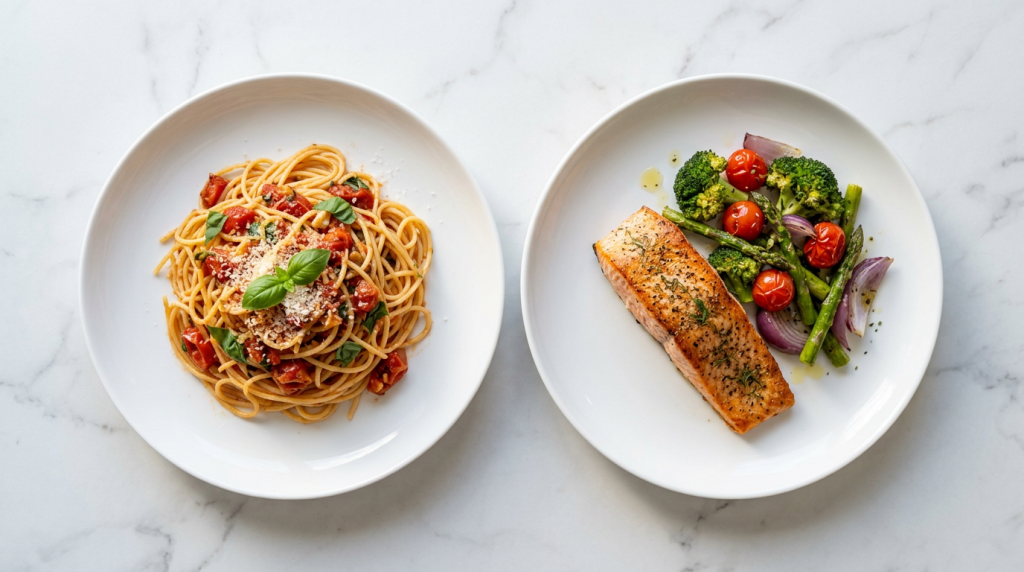
The number that matters is not grams of protein. It is grams of protein per hundred calories. Two meals can have identical calorie counts and completely different outcomes for your muscle, your metabolism, and your long-term weight.
Protein per 100 calories — same calories, different outcomes
| Meal | Calories | Protein | Per 100 cal |
|---|---|---|---|
| Pasta with tomato sauce | 400 kcal | 8g | 2g |
| Takeout pad thai | 800 kcal | 20g | 2.5g |
| Lentils with roasted vegetables | 400 kcal | 30g | 7.5g |
| Salmon with roasted vegetables | 400 kcal | 35g | 8.75g |
Same calories. Completely different effect on muscle retention and metabolism.
During the weight loss phase, when GLP-1 is reducing how much you eat overall, this ratio matters more than almost any other variable. Eating less but not eating for protein density means actively lowering your metabolic floor with every meal, not through any failure of character, but through a mechanical process most people never knew was happening.
Why the Regain Is So Fast
Now fast forward. The medication stops. Hunger returns, real hunger, the kind that was there before the prescription. Appetite normalizes. You go back to eating the way you always ate, more or less, because that is what normal feels like.
But your body is not the same body it was. You have less muscle than when you started. Your metabolic floor dropped during the weight loss, quietly, meal by meal. The old way of eating, the one that once maintained your previous weight, is now a surplus. The calories that kept you steady before now push you over.
The weight returns. And because muscle is significantly harder to regain than fat, it returns as fat. Body composition shifts in the wrong direction even if the number on the scale eventually stabilizes.
This is the mechanism the studies are measuring. A body with less muscle running on the same fuel it used when it had more. The same slow arithmetic that built the weight over years now reasserts itself, often much more quickly, because the protective conditions the medication provided are gone.
A mechanical problem. Which means a mechanical solution exists.
The Question That Changes Everything
Every diet you have ever tried asked the same question in different clothing. How little can I eat? Which foods are forbidden? How long can I sustain this?
Those questions lead to the same place. Restriction, endurance, eventual failure, and a body that has adapted downward to survive the restriction.
The question that actually changes your trajectory is different. Not how little can I eat, but how much protein can I deliver per hundred calories.
That question reframes everything. It is not subtractive. It is not about endurance or denial. It is about building meals deliberately around a specific outcome, protecting the muscle that protects your metabolism that protects the weight loss.
It still requires intention. Changing how you cook, what you buy, how you think about a plate does not happen automatically. But intention applied to the right question produces a completely different result than intention applied to restriction. One builds something. The other just holds the line until it breaks.
And critically, it is a question you can answer in a kitchen. No prescription required. No clinic or program. Just the principle, applied consistently.
Where the Kitchen Becomes the Tool
Restaurant food, packaged food, and takeout are not designed for protein density. They are designed for shelf life, profit margins, and palatability at scale. Those goals rarely align with protecting your muscle.
When you cook, you decide the ratio. You decide that the base of the bowl is fish or chicken or lentils or eggs, not noodles. You decide that the sauce builds on protein rather than just fat and sugar. You make the call that outsourced food cannot make for you, because outsourced food does not know what your body needs right now.
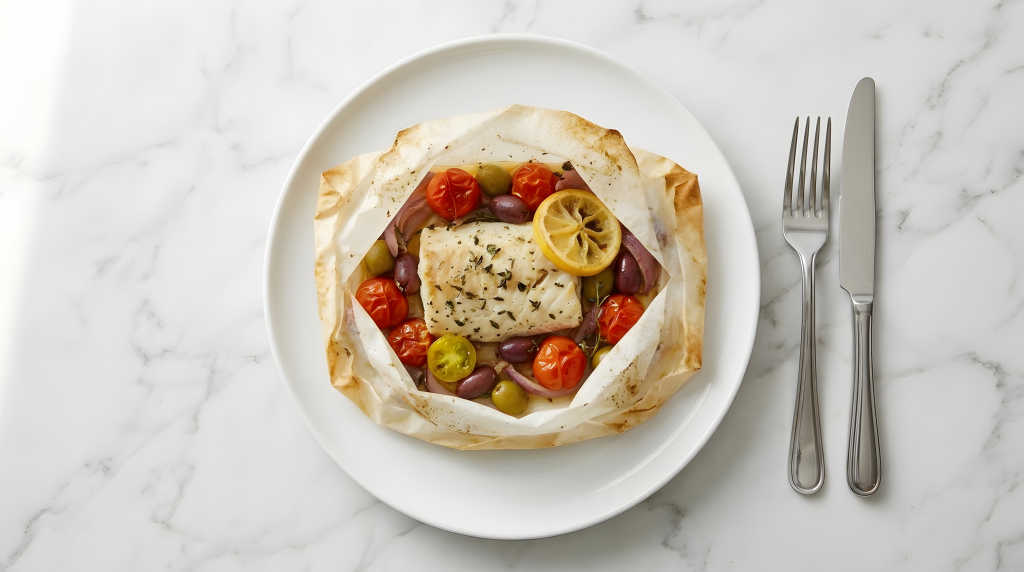
Take Mediterranean Cod en Papillote: cooked in parchment so the kitchen stays nearly scent-free, 35 grams of protein, straightforward enough for a weeknight. Or the Chive Custard Breakfast Bake: eggs and cottage cheese delivering sustained protein from the first meal of the day, before the decisions get harder. Neither feels like compliance food. Both are doing exactly the right work.
You do not need to track every gram. You do not need a spreadsheet or an app. You need to understand the principle and build a small repertoire, ten or fifteen meals, that deliver it. Meals you actually look forward to. Meals that do not feel like medical compliance, that could sit on the table in a decent restaurant and hold their own against anything else on the menu.
That last part is not a luxury. Biology seeks pleasure from food, and that is not a weakness to manage but a feature to work with. If the meals are joyless, you will not cook them. You will find workarounds. You will revert, not because willpower failed, but because nobody sustains something that feels like punishment. The food has to be genuinely good. Not diet-food good. Actually good.
A recipe engineered purely around macros is a chore. A recipe that hits the right numbers because it was built by someone who cares how food tastes is something you make again.
The Path Forward
Your determination and will matters, but it has to be applied where it matters.
If you try to fight your way through your weight loss as if it was a war, where good food is the enemy, odds are you will end up on the casualty list. When the viewpoint shifts from what you must deny yourself to choosing between foods you like, your kitchen stops being a battlefield.
In the end, food isn’t complicated. Neither is making it. And no one is watching over your shoulder to check your plating skills or if you eat it straight out of the pan.